OpenCode
OpenCode harness
Its own session, disposable workspace, events and report. Readiness and configured provider access are required before execution.
 SENTRYINDEPENDENT AI CODE REVIEW & QAOBSERVE.
Review code through independent AI investigations, preserve the evidence behind every finding, and understand what was verified—and what wasn’t.
OpenCode · DeepSeek · GLM via Claude Code
Independent investigations. Separately attributable evidence.
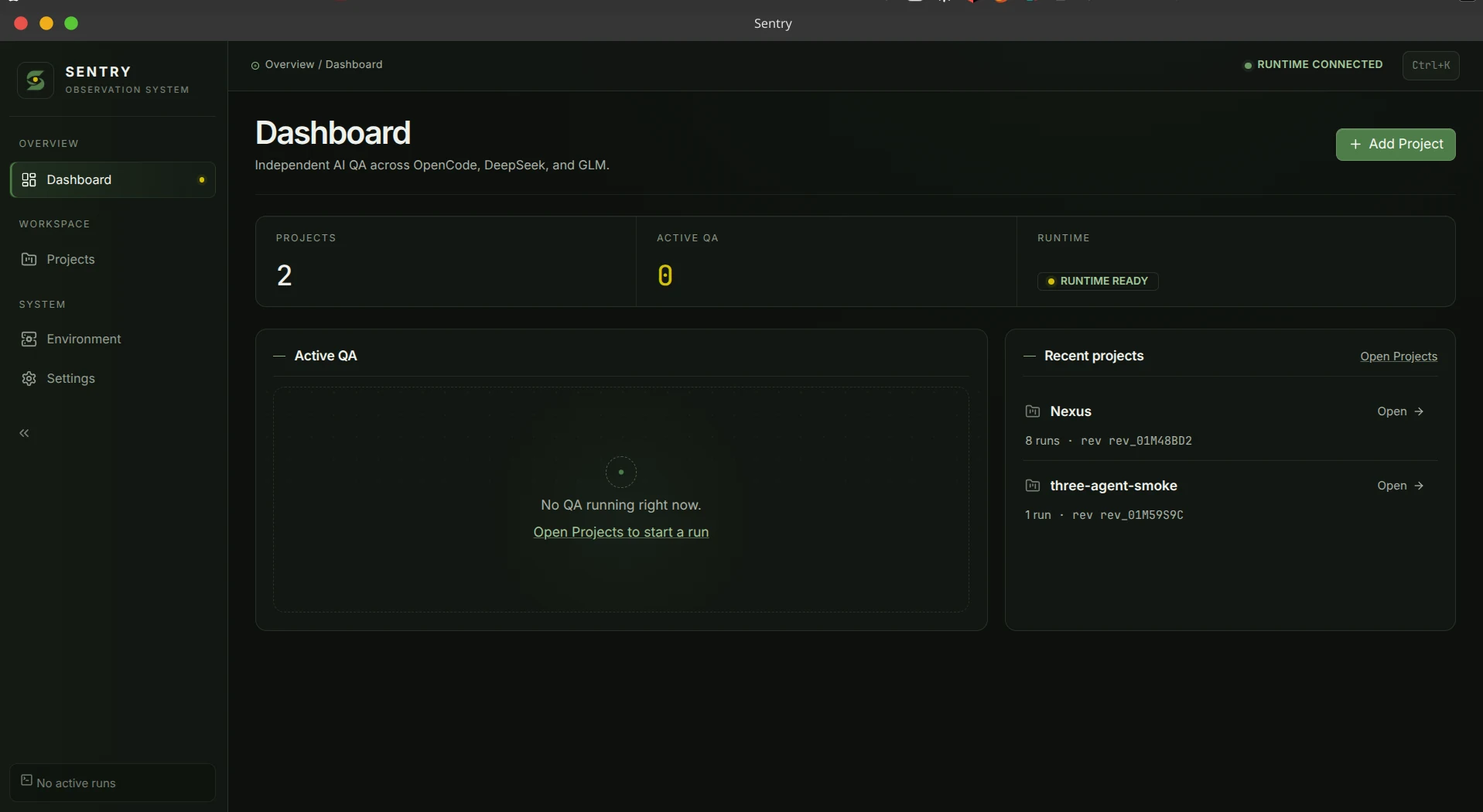
Follow a frozen revision through three separate investigations. Every movement represents an architecture boundary, an evidence relationship or a change of representation.
Skip the experience ↓A review starts in Sentry Desktop or its supported CLI broker. The Linux runtime owns the work; the interface presents its recorded state.
The supported CLI is a frontend through Desktop. Neither renderer nor CLI owns the canonical database or constructs its own harnesses.
The runtime freezes a manifest and source bytes from the managed revision. Every selected harness receives the same baseline in its own workspace.
Full QA and Targeted QA use the same independent-agent topology. Targeted QA freezes a TargetSpec and validates it against manifest entries, including the intended focus and dependencies.
One source becomes separate investigations. Only selected harnesses receive work; a visible inactive option has not executed.
Selected adapters are preflighted and launched concurrently. These are three implementations, not quality, security and correctness departments.
Each selected harness independently plans and investigates in a disposable private workspace. It does not write into its peers’ workspace or the retained snapshot.
The workspace factory associates baseline hashes and snapshot identity with each AgentRun. Durable artifacts and records remain after ordinary workspace cleanup.
Follow an authored code reference from an observation to a finding. A source-based concern is not a reproduced failure, and agreement cannot manufacture stronger proof.
All code, identities and findings in this film are illustrative. No repository is imported, no provider is called, and no code or test is executed.
The example investigators reach different outcomes. Completed peer results and usable partial output remain visible even when another harness fails.
In this sample DeepSeek’s AgentRun is failed with usable evidence, labeled partial output. All completed yields completed; otherwise usable output yields partial; no usable output yields failed. Runtime cancellation has separate precedence.
Results arrive in the shared run overview while retaining their originating harness, evidence and status. Spatial convergence is collection, not an AI merger or verdict.
No mandatory merger, verifier, clustering, deduplication or agreement-based confidence upgrade is introduced. Historical and retest compatibility records are a different path.
Select a harness result and inspect its finding, source reference, snapshot identity and limitation. A failed reviewer is never silently presented as complete.
This DOM presentation follows inspected fields and UI structure. It is authored sample data, not a live application or genuine persisted run.
Sentry remains an independent application. Its recorded results can inform the next engineering decision without granting execution or completion authority.
An optional return toward Nexus is intended ecosystem architecture. The inspected native Nexus Sentry page does not expose a working Sentry API.
Each selected harness independently plans, investigates and reports. They are not three fixed departments. A similar observation from two reviewers still needs its own evidence.
Its own session, disposable workspace, events and report. Readiness and configured provider access are required before execution.
Its own session, disposable workspace, events and report. Readiness and configured provider access are required before execution.
Its own session, disposable workspace, events and report. Readiness and configured provider access are required before execution.
Full QA investigates the project broadly. Targeted QA freezes an explicit focus against the snapshot manifest, with investigation of relevant dependencies. The selected harnesses remain independent in both modes.
This comparison changes scope, not execution topology.
Know who reported the concern, where its evidence came from and which frozen revision it describes. Source inspection remains different from a reproduced failure.
Illustrative identity chain. No executed test, confidence upgrade or live finding is implied.
Managed projects, review history and independently inspectable agent results keep the work understandable after an investigation ends.
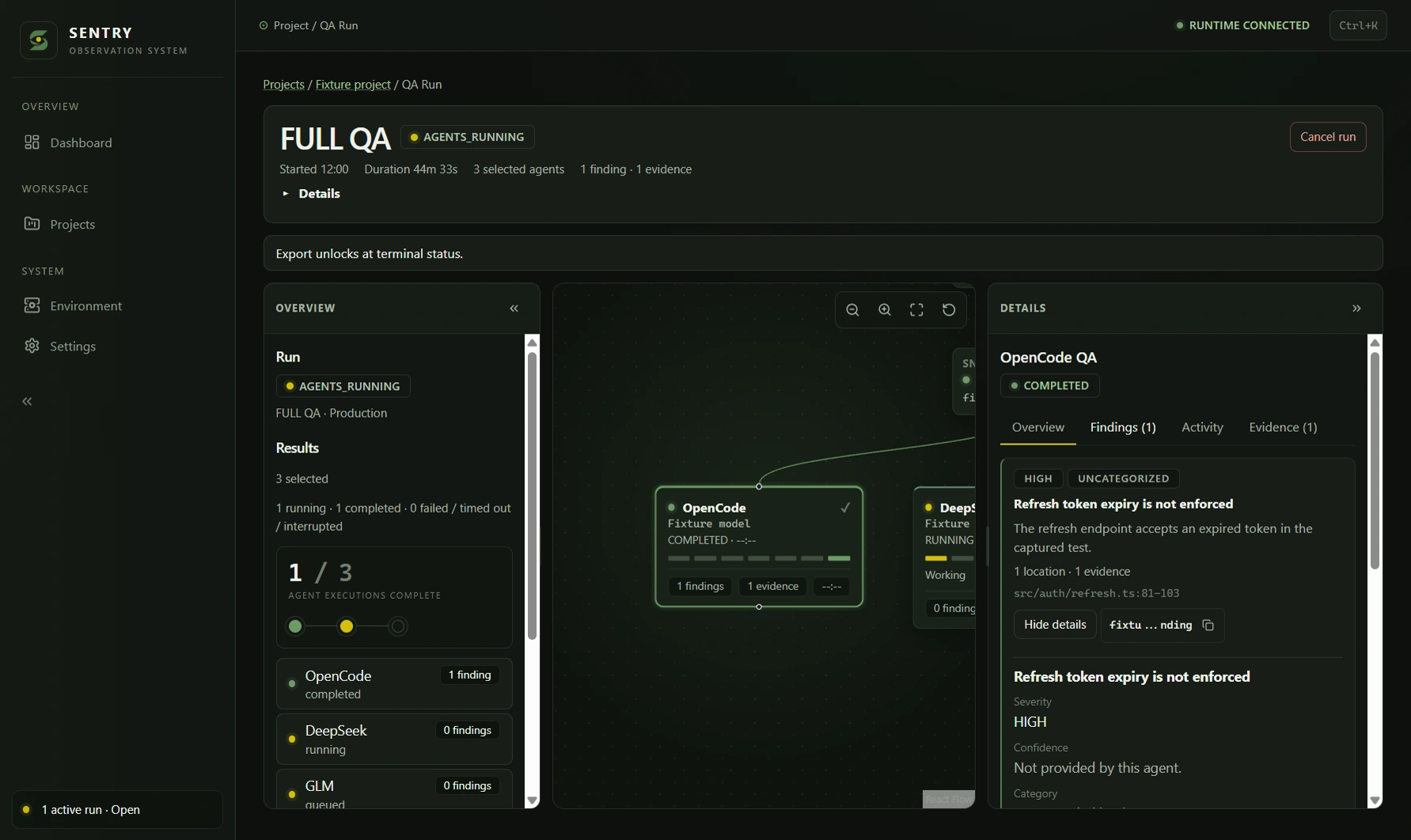
Project operations preserve managed revisions and snapshot identity.
The runtime owns cancellation and settlement. A disconnected interface does not prove a run has stopped.
Findings and evidence survive ordinary disposable-workspace cleanup.
Terminal-run exports retain individual results and provenance.
Desktop and the packaged CLI use the same projects and canonical review history. Open Desktop first; the CLI talks through its supported broker.
VERIFIED COMMAND REFERENCE / NOT LIVE OUTPUTsentry open
sentry cli capabilities --json
sentry cli project list --json
sentry cli run status run_ID --json
Replace run_ID with a real run identity. No command is executed here. Credentials remain in Desktop settings; client identity is informational, not authentication.
The Linux runtime owns SQLite persistence, coordination, adapters and project operations. Desktop main owns runtime connection, host path translation, credentials and native export dialogs. The renderer reads snapshots. The CLI never creates a separate domain database or its own agents.
Sentry is an independent application in the ArthurLabs ecosystem. The intended Nexus relationship carries scope and evidence into review and returns findings to the relevant work.
Native Nexus integration is unavailable in the inspected Desktop. A supported Sentry CLI contract does not establish an implemented Nexus UI connection.
Install Sentry as its own application. Review the prerequisites, verify the archive, and configure the harnesses you intend to use.
x64 · Unsigned ZIP · online runtime bootstrap
122.9 MB · packaged production CLI included
This is an unsigned archive with online WSL bootstrap. It is not a signed installer or an offline package.
Fresh installation & upgrade instructions ↗sentry-1.0.2-2640efcd7874-windows-x64.zip
SHA256: 5265713af248297c543bf0d41093258bd0e7d8c177e0b1c544e733750347286f
Source: 2640efcd78744cb02c517a405e648722e662bd60Published release metadata checked 22 October 2026. Native Linux Desktop is deferred; macOS support is not established. The Linux execution runtime through WSL2 is a separate requirement.
Installation guidance and implementation references belong alongside the download. Explore Sentry independently, or see its intended place in the wider ArthurLabs workflow.
Published archive, WSL setup, provider prerequisites and upgrade instructions.
Read release & installation notes ↗The production pipeline contract distinguishes separate investigations from historical finalization concepts.
Read the architecture ↗Inspect the published source revision behind this verified distribution. No live run is performed by this website.
Explore the source ↗Arthur Studio holds ideas. Nexus coordinates work. Sentry investigates independently. Their connected workflow remains a conceptual demonstration where integration is unavailable.